Mediterranean Breeds – The Bichons
Meet Mediterranean Bichon breeds in this beginner’s guide to their origins, traits, grooming, and what to know before choosing your furry companions.

A small, cheerful companion can bring a lot of company into a home, but these dogs also need people and regular care. Mediterranean Bichon breeds include related small companions, though this guide focuses mainly on the Bichon Frise and Havanese. Both can suit a family looking for an affectionate dog, but their needs deserve as much attention as their appealing looks.
Companionship, coat care, and time with people all matter when you choose a breed. A friendly lapdog may still be a poor fit for a home where it is routinely left alone for long stretches. Before you fall for a fluffy puppy, think about the hours you are home, the care you can keep up with, and the dog’s place in your household.
This guide will help you compare the breeds’ histories, everyday needs, and care demands. The best match is one you can support through ordinary days, not only special outings.
Choose with your daily routine in mind, not just the appeal of a fluffy coat.
Key Takeaways
- The Bichon Frise and Havanese are related companion breeds, not the same breed.
- Both dogs need regular time with people and consistent training.
- A Bichon Frise coat requires daily brushing and regular professional grooming.
- Havanese grooming needs depend partly on coat length.
- Plan walks and outdoor time around your dog’s age, health, and the weather.
- Ask about health records and preventive care before choosing a dog.
What counts as a Bichon-type breed?
“Bichon” can refer to a related family of small companion dogs, not just one breed. The name is a family label, while each breed has its own identity and history. The Bichon Frise and Havanese are two members that are often compared by people looking for a small companion.
Four breeds are commonly grouped as Barbichon-type dogs: they share a family resemblance and a companion-dog role, but they are not one identical breed. The group includes:
A Bichon family label connects related companion dogs; it does not make their breeds interchangeable.
- Bichon Frise
- Maltese
- Havanese
- Bolognese
These small lapdogs were traded around the Mediterranean basin for millennia. Travel helped related dogs reach new ports and households, where local preferences shaped distinct types. The breeds retain a general companion-dog role, but the shared role does not mean every dog has the same temperament or daily needs.
Names and historical groupings can be confusing when you first compare dog breeds. “Bichon” may describe a breed name, a type of dog, or a broader family grouping. Barbichon is another term used for this related group, which is why a quick search can seem to treat several breeds as one.
A familiar family label does not mean the breeds have identical histories or care needs. A Bichon Frise’s coat routine, for example, differs from the Havanese options, and their origin stories are distinct. For a future owner, the breed name matters more than a broad family resemblance.
When you speak with a breeder or rescue organization, ask which specific breed the dog belongs to and what that dog needs each day. That keeps a general label from obscuring important differences in behavior, coat care, or health. Treat the family label as a starting point, then compare the individual breed you are considering.
How did Mediterranean Bichon breeds develop around the sea?
Small lapdogs traveled across the Mediterranean for millennia, so related dogs developed along more than one route. Trade carried them between ports, and sailors helped spread small companion dogs from place to place. The broad pattern is clear, though not every detail in these dogs’ early history is certain.
The Bichon Frise and Havanese have separate regional histories. The Bichon Frise’s modern development is linked to Tenerife, while the Havanese’s is linked to Cuba. Those connections explain why related dogs should not be treated as one breed with different names.
From Mediterranean trade routes to European courts
Small lapdogs moved around the Mediterranean basin through trade over many centuries. Their appealing size and companion role helped them find homes well beyond the ports where sailors first encountered them. As dogs traveled, local breeding and changing preferences created different types.
The Bichon Frise became associated with European nobles sometime in the 13th century. That association added courtly status to a dog whose history also involved trade and travel. Historical accounts do not establish every step of its route, so the story is best understood as a broad movement rather than a single proven journey.
The name Bichon Frise refers to the modern curly-coated breed developed from the Tenerife type. The Bichon Tenerife is described as its primary ancestor. France recognized the breed in March 1933 as the “Bichon a Poil Frisé,” a formal name that reflected its distinctive curly coat.
Tenerife and Cuba shaped two distinct breed histories
The Havanese descended from the Blanquito de la Habana, a small Bichon-type dog brought to Cuba by Spanish settlers. The breed’s Cuban roots distinguish its history from the Tenerife route associated with the Bichon Frise.
After the 1959 Cuban revolution, Cuban families fleeing to the United States brought Havanese dogs with them. The current U.S. breed population descends largely from those dogs. That history connects the breed’s modern American presence to families who carried their pets with them.
| History detail | Bichon Frise | Havanese |
|---|---|---|
| Key ancestor | Bichon Tenerife | Blanquito de la Habana |
| Place linked to modern development | Tenerife, Canary Islands | Cuba |
| Historical route | Tenerife type linked to later European development | Spanish settlers brought its ancestor to Cuba |
| Formal recognition | France, March 1933, “Bichon a Poil Frisé” | Not stated here |
The Bichon Frise Club of America was founded in San Diego in 1964, long after the breed’s Mediterranean roots.
How do Bichon Frise and Havanese compare in size and lifespan?
Both breeds are small companions, but their published weight and height ranges are not identical. The Havanese is lighter on average, while the Bichon Frise’s stated weight range reaches 18 pounds. Neither set of figures predicts the exact adult size of an individual dog.
The Bichon Frise averages 12-18 pounds and 14-15 years of life; the Havanese weighs 7-13 pounds and has a 14-16-year lifespan. These measurements are breed ranges or averages, not a promise about a particular pet.
| Measure | Bichon Frise | Havanese |
|---|---|---|
| Weight | Average of 12-18 pounds | 7-13 pounds |
| Height | Just under 1 foot tall | 8.5-11.5 inches at the shoulder |
| Average lifespan | 14-15 years | 14-16 years |
| AKC recognition | Full recognition in April 1973, Non-Sporting Group | Recognized in 1996 |
On the scale, the ranges overlap: a Bichon Frise at the lower end can weigh about as much as a larger Havanese. The height figures also use different wording. The Bichon Frise is described as just under one foot tall, while the Havanese figure measures height at the shoulder.
The American Kennel Club granted the Bichon Frise full recognition in April 1973 in the Non-Sporting Group. It recognized the Havanese in 1996. Recognition dates can help you understand breed history in the United States, but they do not tell you which dog will suit your household better.
Choosing between two similarly small companions should also account for grooming and daily routine. Think about how much time you can give to coat care, training, and company, not only whether a dog fits on your lap or in your car. Ask about the adult size and health history of the particular puppy or dog you are considering.
What does a Bichon Frise coat mean for allergies?
A Bichon Frise’s rounded, fluffy outline comes from two coat layers, not from a coat that is allergen-free. The double coat has a soft, dense undercoat beneath a coarser outer coat. Those layers help create the breed’s signature powder-puff silhouette.
Low shedding does not guarantee low allergen exposure or an allergy-safe visit. The AKC rates Havanese shedding 2 out of 5, while the Curex page rates Bichon Frise shedding 1 out of 5. A shedding rating describes hair loss, not whether a person will react.
Why the coat looks like a powder puff
The Bichon Frise coat is curly and coarse on the outside, with a softer, dense layer underneath. Its shape can look like a rounded cloud, especially when the hair is kept in the breed’s familiar full style. The breed standard describes dark, alert eyes and a plumed tail.
White is the standard color, with up to 10% buff, cream, or apricot shading. The coat’s texture and color help define the breed’s look, but neither one tells you how a person with allergies will respond. A fluffy appearance is not proof of reduced allergen exposure.
What “hypoallergenic” can and cannot promise
Allergy symptoms can involve exposure to Can f 1, a dog allergen found in hair and homes. A 2012 study found a geometric mean of 2.26 µg/g Can f 1 in hair from marketed-hypoallergenic breeds, compared with 0.77 µg/g in other breeds. The difference was statistically significant (P<.001).
A 2011 study detected Can f 1 in 94.2% of 173 single-dog homes. It found no difference between homes with marketed-hypoallergenic breeds and homes with other dogs. These findings show why shedding and allergen exposure are not the same measure.
Individual human sensitivity varies, so a breed label cannot guarantee a reaction-free visit. Some people may react to one dog and not another, even within the same breed. If allergies are a concern, spend time with the individual dog before bringing it home.
Will a Bichon Frise fit your family and home?
A Bichon Frise often enjoys being included in family life, but may struggle with long stretches alone. People time matters for this attention-seeking companion, especially in a busy home where family members come and go.
A Bichon Frise may bark at small sounds or become distressed and destructive when left alone for long periods. Training helps, but it does not replace daily companionship. Plan for the dog to spend time with people rather than routinely waiting by itself all day.
How they interact with people and other pets
Bichon Frises are described as friendly with children, strangers, other dogs, and other pets. That general temperament can make the breed a good family companion, but an individual dog’s behavior depends on its experiences and socialization.
Introduce a new dog to children and other pets gradually, and supervise their interactions. Even a sociable dog needs time to settle into a new home. Children should learn to handle the dog gently and give it space when it rests or moves away.
A Bichon Frise may alert you to a small sound with barking. That can be useful in a home, but it may become tiring in an apartment or on a busy street. Reward quiet behavior and make sure the dog has a predictable routine instead of scolding every alert bark.
Training for good manners and time apart
House training can be difficult, so start early and keep the routine steady. Positive reinforcement helps the puppy connect a wanted behavior with a reward. Obedience classes can also benefit both dog and owner by giving you guided practice and a chance to build good habits.
Use these four training priorities as a practical start:
- Reward desired behavior as soon as you see it.
- Start house-training routines early and keep them consistent.
- Practice calm separation in small steps.
- Teach a reliable recall for coming when called.
Separation practice should begin with short, calm periods and build gradually. A puppy that is comfortable for a brief absence is not automatically ready for a full workday alone. Plan for patient house-training and calm alone-time practice rather than expecting either skill to happen automatically.
How much exercise and heat care do these dogs need?
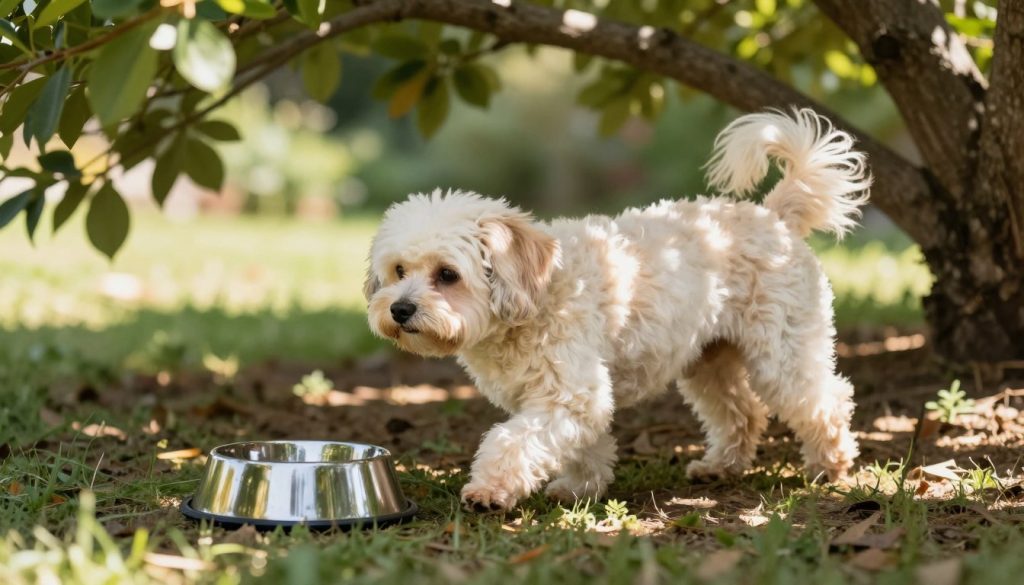
A Havanese needs 30-45 minutes of daily exercise, while outdoor plans for either breed should also account for weather. Short walks and play suit many companion dogs, with activity adjusted to the dog’s age and condition.
For a healthy adult Bichon Frise, 62-78°F (17-26°C) is described as comfortable; above 88°F (31°C) is a medical-risk threshold. Heat tolerance can narrow with age or health conditions, and puppies and dogs over 8 years have narrower tolerances.
Daily movement and mental activity
Regular walks, indoor play, and short training sessions can give a small dog useful movement and mental work. A companion dog does not need every walk to become a long outing. A few short, engaging activities can be easier to fit into apartment living than one demanding trek.
Offer play that asks your dog to focus, such as finding a toy or practicing simple tricks. Adjust the pace if the dog seems tired, and keep fresh water available. For a Bichon Frise weighing 12-18 pounds, estimated daily water needs are 14-22 ounces, rising to 22-32 ounces in summer.
Warm-weather limits and travel safety
Heat calls for close attention, especially when a dog is active outdoors. Above 82°F (28°C), active monitoring becomes essential, and water should be offered every 15 minutes. A dog’s behavior matters alongside the forecast, since heat can build quickly during play or travel.
| Temperature or situation | What it means | Practical response |
|---|---|---|
| 62-78°F (17-26°C) | Comfort range for a healthy adult Bichon Frise | Plan ordinary outdoor activity and offer water |
| Above 82°F (28°C) | Active monitoring is essential | Offer water every 15 minutes |
| Above 88°F (31°C) | Medical-risk threshold for Bichon Frises | Limit outdoor exposure and watch the dog closely |
Core body temperatures above 104°F (40°C) indicate heat exhaustion. Above 106°F (41°C), organ injury can occur within minutes. These are serious thresholds, not targets for deciding whether a dog can keep exercising.
For long trips, stop every 90 minutes. In warm weather, keep outdoor breaks under 10 minutes. Begin heat acclimatization with 5-minute outdoor sessions, then increase gradually over 4-6 weeks. In warm conditions, shorten outdoor breaks and respond to the dog’s condition rather than relying on temperature alone.
How much grooming do Bichon Frise and Havanese coats need?
Keeping these coats comfortable and tidy takes a recurring routine, even when a Havanese wears a shorter puppy cut. Daily brushing is central to Bichon Frise care, while a Havanese’s brushing schedule depends on coat length.
A Bichon Frise needs daily brushing, monthly baths, and regular professional grooming appointments. A Havanese with a long coat also needs frequent brushing, while the puppy cut reduces brushing needs without removing professional upkeep.
Maintaining a Bichon Frise coat
Brush a Bichon Frise every day to catch tangles before they tighten into mats. The dense undercoat and curly outer hair need steady attention, especially around areas that rub or collect debris. A short daily session is often easier than trying to undo several days of knots.
Plan for monthly baths and regular appointments with a professional groomer. The groomer helps maintain the breed’s distinctive outline and keeps the coat manageable. Ask how to brush sensitive areas, including around the ears, so home care stays comfortable for the dog.
A Bichon Frise’s grooming needs are part of its ongoing care, not an occasional extra. If you enjoy coat care, the routine can become a calm time with your pet. If daily brushing does not fit your schedule, think carefully before choosing this breed.
Choosing a long coat or puppy cut for a Havanese
A long Havanese coat calls for daily brushing, a bath every 1-2 weeks, and professional trimming every 4-6 weeks. This style takes more regular effort, since longer hair can catch tangles more easily. It also gives you a different look from the shorter cut many pet owners prefer.
A Havanese puppy cut calls for brushing every few days and professional grooming every 6-8 weeks. The shorter hair can make brushing less frequent, but it does not eliminate salon visits or basic coat care. You still need to check for tangles and keep ears clean and comfortable.
A neglected coat can become matted, making routine care easier than catching up after tangles form. Choose a coat length you can maintain consistently, not just the style you prefer in a photo.
Which health and breeder checks matter before choosing?
Ask about health testing and routine preventive care before committing to a puppy or adult dog. Records matter because they help you understand the risks a dog may face and what care it may need.
For a Havanese, ask the breeder about hip, patella, and cardiac evaluations, an eye exam, and relevant DNA tests. Bichon Frise owners should discuss the breed’s common health concerns and preventive care with a veterinarian.
Ask for screening results before you choose a Havanese puppy, and review them with your veterinarian.

Health concerns to discuss with a veterinarian
Bichon Frises are prone to diabetes, eye conditions, bladder stones, and dental disease. Home dental care includes brushing with a dog-friendly toothbrush and toothpaste. Plan veterinary dental exams and cleanings at least once a year.
Eye problems can appear early, so do not wait for obvious vision trouble before discussing eye care. Corneal dystrophy may develop as young as 2 years old, and cataracts may begin developing at 6 months old. Ask your veterinarian what eye checks suit your dog’s age and health history.
Havanese health concerns include CDDY/IVDD risk, progressive retinal atrophy, congenital deafness, mitral valve disease, patellar luxation, hip dysplasia, and Legg-Calvé-Perthes disease. The list does not mean an individual dog will develop these conditions. It gives you useful topics to raise when you review a dog’s history.
Screening questions for a Havanese breeder
Ask the breeder to share results for the recommended evaluations and tests, not just a general statement that the parents are healthy. A responsible conversation should leave you clear about what was checked, when it was checked, and which parent each result belongs to.
Use this checklist when you discuss Havanese screening:
- OFA hip evaluation
- OFA patella evaluation
- OFA cardiac evaluation
- CAER eye exam
- PRA, BAER hearing, and CDDY/IVDD DNA tests
Ask the breeder for the records and discuss breed-specific risks with your veterinarian. Review screening records with your veterinarian and arrange regular dental and eye care after bringing a dog home.
Conclusion
The right small companion is the one whose needs fit your everyday life. Your household’s time, grooming commitment, and willingness to maintain training and preventive care all matter more than a breed’s looks alone.
Make one concrete next step: meet a Bichon Frise or Havanese in person, then ask about the dog’s coat routine, comfort with time apart, and health records. Pay attention to how the dog responds to people and the setting, not only how it looks in a photo.
Before choosing, meet the dog and bring your care and health questions to the breeder or rescue organization.




1 thought on “Mediterranean Breeds – The Bichons”